
Blog ·
Is Xbox2Windows an Emulator? No. Here Is How Recompilation Works.
Xbox2Windows researches ahead-of-time code translation. Learn when emulation, compatibility layers and recompilation apply to games from different console generations.
Xbox2Windows is a static recompilation research project for Xbox Series software. It translates selected CPU code and GPU programs ahead of execution, while mature emulators such as Xenia cover older console generations. The techniques differ in which work happens before launch, which happens at runtime and what still needs a host operating-system implementation.
Emulation: simulate the console
An emulator runs the console’s original machine code on your CPU, either by interpreting it or by translating it in blocks at runtime (JIT), and reimplements the console’s hardware well enough for games to notice nothing.
- Strength: if it works, it works for the game as shipped — no per-game rebuild.
- Cost: accuracy. Each console generation is a much larger surface than the last.
What exists and is playable:
- Original Xbox — xemu. Mature enough to be the default answer for that generation.
- Xbox 360 — Xenia. Mature, with per-game configuration and a compatibility list worth reading before you install anything.
What does not exist: a playable Xbox One emulator or Xbox Series X|S emulator. Pages claiming either are selling something else.
Compatibility layers: native code, fake system
A compatibility layer does not simulate the CPU. It runs the game’s native code and reimplements the console’s operating system surface — the libraries the game calls — on top of Windows. Wine is the familiar desktop analogue.
The Xbox-side example is XWine1 for Xbox One software. Its developers describe a small number of titles as fully playable and the rest as stopping early — at a logo or before gameplay. That is a developer claim; independent verification per title is the only way to trust it, and per-title results change with updates.
Shared x64 instructions remove the need to translate many CPU instructions for some recent Xbox software. A compatibility layer still needs to reproduce the guest program’s expectations about memory, threads, libraries, audio, graphics and I/O.
Static recompilation: translate ahead of time
Static recompilation takes the console binary apart offline: it lifts machine code to an intermediate representation, emits C++, and compiles that into an ordinary Windows executable. Shaders get converted separately — on modern Xbox hardware, RDNA2 shaders need to become something a desktop GPU driver accepts, such as DXIL.
This is the approach behind Xbox2Windows and Leonida.
Translating ahead of time can avoid translating the same CPU code repeatedly. It also moves decisions about discovering code and preserving behavior into the build. Several difficult tasks remain:
- You must reconstruct every library call the game makes, since the console OS is gone.
- Code and data can be indistinguishable, and games compute jump targets dynamically — the classic failure mode of ahead-of-time translation.
- Assets and file layout still need a loader that the game accepts.
The honest status of the Xbox2Windows project, in its own words: source-built Windows binaries run from entry to process exit, the main executable is not in the public package, and title CPU execution, full boot and frame rate are all unverified. Its published artifacts are a GPU check build and source. Leonida reports bulk shader conversion and no booting game.
What a translated CPU routine preserves
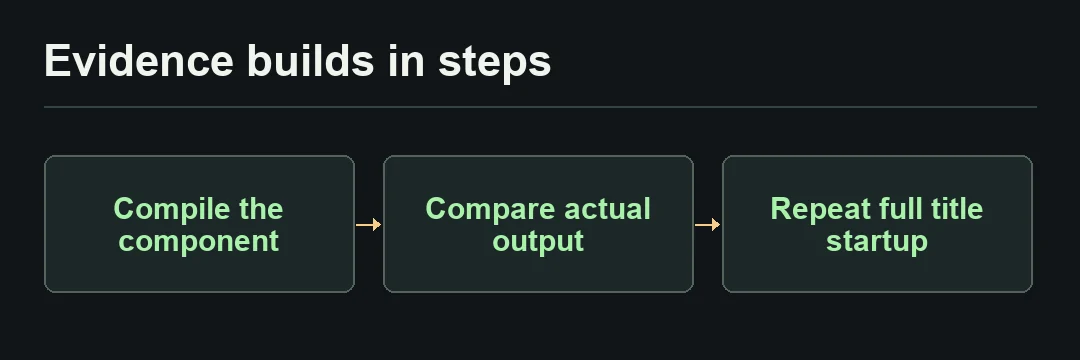
Consider a test routine that reads numbers from a structure, updates a counter and returns an error code when the input is missing. A lift must preserve field offsets, the signedness of the comparison, side effects and the calling convention. Return values alone are insufficient when a caller also expects memory to be updated. Researchers can build their own test input for the original and translated versions, run both with the same data and inspect the observable difference. They can also intentionally change a branch in a control case to confirm a test would catch an incorrect translation.
The same test is easier to reproduce than an entire title startup. The input is already understood and belongs to the test. It avoids dependencies on an expected console environment that can otherwise make an apparent failure ambiguous. A detailed result usually records the program, revision, host toolchain and the exact behavior checked. The presence of hundreds of such results helps explain the project’s direction. Evidence for a whole commercial executable still requires that executable’s own important control paths and services to work together.
What happens to the graphics work
In the graphics pipeline, one stage can sample a texture while another emits vertices or writes into a buffer. The host compiler can accept a translated program even if the surrounding runtime binds the wrong resources. A controlled test sets known inputs, runs the host shader and compares output pixels or buffer bytes. Another test may use a software graphics adapter as a second reference. A difference could come from input formats, rounding, resource assignments, shader semantics or synchronization. Good tests constrain those possibilities by checking a focused scenario and documenting the conditions.
Two projects can report incompatible-looking shader numbers because the counts refer to different milestones. One may catalog how many records it translated and validated structurally. Another may count only records which also produced a matching readback with selected resource bindings. Check the denominator, shader stage, validation step, adapter and source revision before comparing results. The experiment catalog records separate pixel and compute observations to preserve those distinctions.
Use the route that answers your question
For a particular Xbox 360 game, the most useful fact is a recent title compatibility report for its exact edition. For a supported original Xbox game, start with xemu and check what its database calls playable. An Xbox One dashboard screenshot can show its startup services progressed, but it does not tell you whether input, saves or later levels work. For Series research, read the project’s current fixture list before interpreting a commit as a playable release. This approach avoids spending time configuring the right program for the wrong console generation.
Which route applies to your console
| Your console | Route that matters | Realistic today |
|---|---|---|
| Original Xbox | Emulation | Yes — xemu |
| Xbox 360 | Emulation | Yes — Xenia, per-game settings |
| Xbox One | Compatibility layer | Partially, per title, per developer claims |
| Xbox Series X|S | Compatibility layer / static recompilation | Research stage, no playable build |
| GTA VI on any of them | Recompilation of the Xbox build | Not booting in any public project |
Why this matters when you read a news post
A headline like “GTA 6 shaders converted for PC” is real progress and a completely different claim from “GTA 6 runs on PC”. The first can be true while the second stays false for a long time.
When you read a project update, look for three things:
- Does the project itself claim a boot, or only that a component compiles?
- Is there a downloadable artifact — and does it come from the project’s own release page?
- Is a hash published, so you can check that what you downloaded is what they built?
If any of those is missing, treat the claim as a work-in-progress report rather than a release.
Checked 23 November 2026. We do not host, mirror or link to game files; links above go to project homepages and repositories only.
Common questions
When does the translator run?
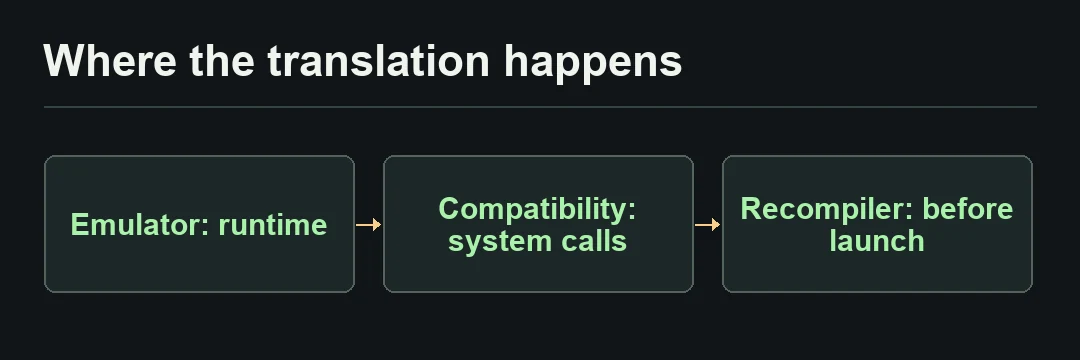
An ahead-of-time translation happens before execution. An emulator can translate guest blocks at runtime. A compatibility layer can run suitable CPU code directly while handling guest system calls.
Does an executable running on the host prove its game works?
A source-built fixture validates what its input and expected output describe. Check the actual title evidence separately.
Which older projects have compatibility reports?
Xenia covers Xbox 360 and xemu covers the original Xbox. Check the exact game and build in each project's own reports.