
Blog ·
Can Xbox Shaders Become Desktop DXIL? Yes, in Tested Cases.
A technical explanation of RDNA2 shader translation, pipeline bindings and how controlled readback establishes output correctness.
Selected Xbox RDNA2 shader programs can be translated into desktop DXIL and tested on Windows. Success depends on preserving the shader’s behavior and recreating the resources and pipeline state that surround it. Xbox2Windows documents controlled output comparisons, and its results describe the particular programs and conditions in the tests.
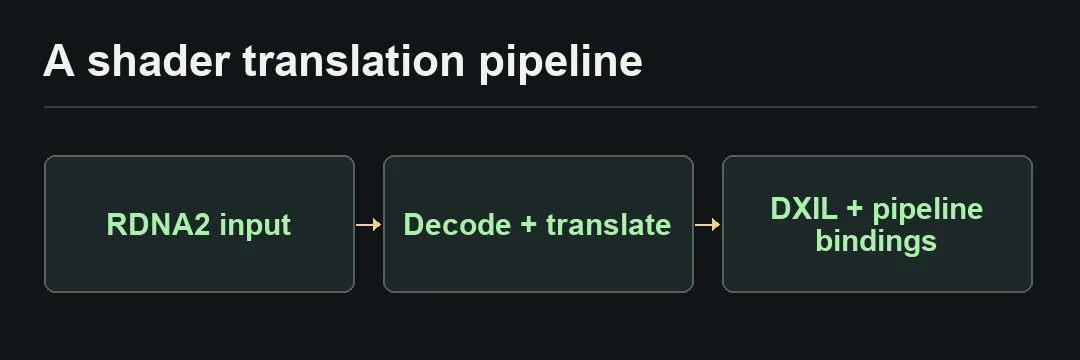
The host driver needs a representation it can consume
A shader is a small program that runs as part of a graphics or compute workload. A pixel shader can compute output color values for a rendered region. A compute shader can write values into a data buffer. Mesh and vertex stages provide geometry-related work for subsequent pipeline operations. Which stage a program belongs to determines how it gets inputs, writes outputs and coordinates with other parts of the workload.
Console-specific GPUs and toolchains can store the programs in forms desktop drivers do not accept directly. Translation interprets the source instructions and transforms their behavior into a representation the target understands. DXIL is part of the modern Direct3D shader toolchain. The desktop compiler and runtime still impose their own rules about what the host program can encode and how shaders can reference resource data. A translator has to preserve behavior while satisfying those rules.
With one translated routine, the team can reason about register reads, data types, branches and operations. It can track whether a source operation has a straightforward equivalent on the host or needs multiple host instructions. It also needs to handle state implicit in the guest, such as channel ordering and which resources represent each binding. A program’s original opcode list alone does not tell you which texture or buffer contained the input the game intended to use.
Bindings connect instructions to data
A graphic operation like sampling a texture requests data through a particular shader slot. The host application has to supply a compatible texture view and sampler at the location the translated shader expects. A test can choose simple known colors to see whether the visible output corresponds to the requested texel. If the wrong binding is supplied, the shader can run without producing the right image. Even a test that draws the right outline can fail in one channel, mip level or addressing mode.
For another example, a compute shader can write through a buffer view to output a sequence of values. The meaning of each write depends on the buffer addressing and data layout. A useful test sets known initial content and checks that the expected bytes changed, while unrelated bytes retained their values. It can repeat the dispatch under a second configuration to exercise different work group counts. Those checks reveal more than whether the runtime successfully accepted the compiled program.
Graphics execution also has state outside the shader’s own inputs. The pipeline specifies formats, sample counts, depth behavior, and other fixed-function settings. A translated shader can be correct for one documented configuration and require additional work for another. Good reports track the inputs and full pipeline state so contributors can isolate whether a failing result comes from translation, bindings or execution conditions.
Compare committed output with a reference
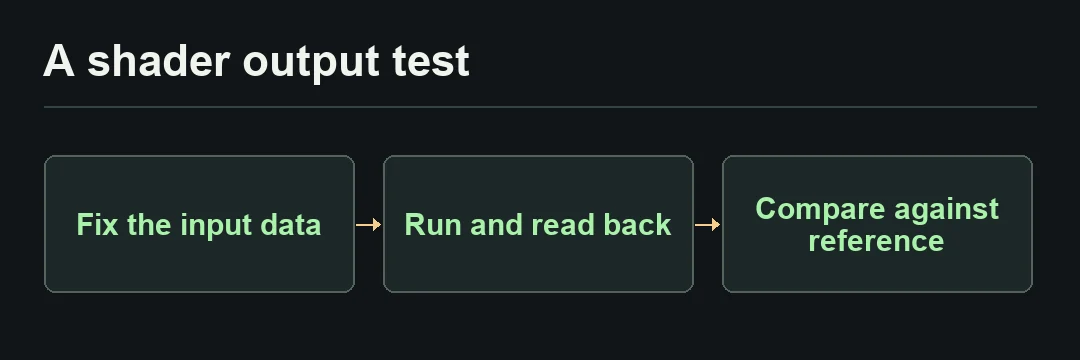
Validation is useful at multiple levels. A compiler and module validator can reject an invalid target program before it runs. A runtime can reject an incompatible pipeline. Execution produces the values that matter to the workload, and readback lets a test inspect those values. Compare against an independently computed CPU result, an existing trusted shader path or another explicitly described reference. Choose a method and describe what tolerance, if any, is acceptable for the result.
A single uniform output deserves scrutiny. If all inputs are identical, several incorrect operations can accidentally return the same result. A stronger fixture varies selected values and captures where they should differ. A deliberate negative control can confirm the conditions really distinguish correct from incorrect outputs. For images, checking every output channel can reveal differences that a small screenshot would hide. For buffers, comparing a full range can catch write offsets and unintended modifications.
A software adapter such as WARP can run parts of the Direct3D workload without requiring the same GPU model. A matching software and hardware result gives a second comparison for that test and driver path. Different adapter features or supported wave widths can still change what a specialized test can run. Read any skip output separately from a true pass or failure. This is particularly important when a feature is available only on specific hardware configurations.
Read the experiment counts by stage
The Xbox2Windows experiment log gives 12,101 pixel shader records in the reviewed scan. The table records 849 as verified under the specified conditions. It separately lists two mesh shader records and 12 compute records. Those values can add up across stages, but the numerator for each test must remain attached to its own denominator. Using the total of pixel and mesh matches against a pixel-only denominator would overstate that specific result.
Leonida reports other milestones for many source records because it targets SPIR-V and Vulkan. Those results describe translation and structural validation under the stated conditions. They can be valuable independent of DXIL output comparisons. A count of accepted SPIR-V programs and a count of matching DXIL readbacks answer different questions. Read the project comparison before drawing conclusions from raw size or count.
Record the part of the pipeline that failed
A translation error can come from an instruction the tool does not support. A pipeline error can originate in the fixed-function state or binding description even after the shader passes validation. If a test launches successfully and returns mismatching values, examine the exact difference between reference and actual output. Keep the original workload, result and shader stage in the report. A future translator change can then be tested against the same case without conflating it with a different program. The open questions become more specific that way, especially when a test can run on two adapters.
A real frame needs the rest of the engine
A complete frame exercises many shaders along with resources, synchronization and CPU-side work. The engine may choose different programs for post-processing, collision, lighting or a later area. Timing, state transitions and library behavior can be important even when an individual translated program runs faster than expected. A useful fixture de-risks that component without making promises about how different components will interact.
For a deeper look, see the experiment catalog and its separate pixel and compute entries. If you are a Windows tester interested in running the published diagnostics, use the official GPU Check and keep the adapter, driver and release tag in your notes. For playing the game today, consult the publisher release tracker. These are different outcomes with different evidence.
Common questions
Why is a successful validation still useful?
It rules out a class of malformed host programs early. Later tests can focus on execution, inputs and output. Keep both results, since an execution problem and a module format error need different fixes.
Does every shader need the same kind of test?
No. A pixel program can be checked with a controlled render target. A compute program may require an output buffer comparison. Use the test case and comparison conditions the source experiment documents.
Why do adapter skips matter?
A skipped test may have no observation of the feature it was designed to measure. Recording the reason prevents a missing feature from being counted as a success or a failed translation. It also helps match runs from different GPUs and drivers.