
Blog ·
Do Xbox2Windows, Leonida and XCL Do the Same Thing? No.
A practical comparison of the CPU, graphics and system-library work happening across the three Xbox Series research projects.
Xbox2Windows, Leonida and XCL solve overlapping Xbox Series compatibility problems using different host environments and tests. Xbox2Windows investigates ahead-of-time CPU and DXIL translation, Leonida documents a Vulkan route for GTA VI, and XCL reimplements system libraries around native x64 code. None of the three has publicly demonstrated a playable GTA VI build in the reviewed sources.
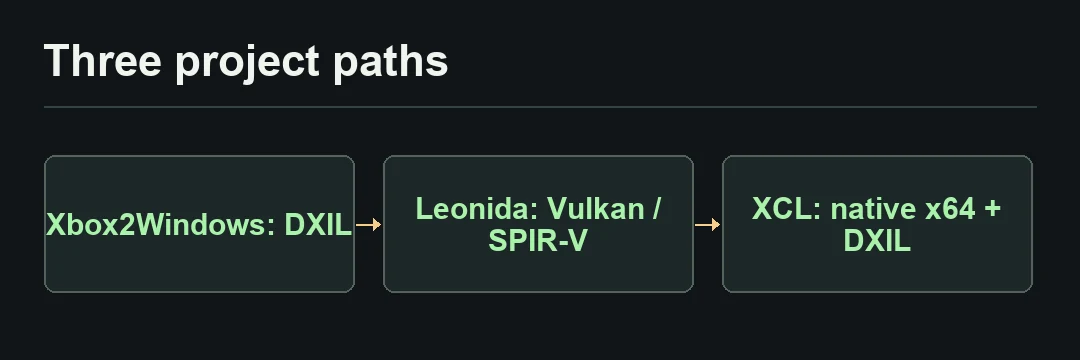
Xbox2Windows shows what a controlled fixture can prove
Xbox2Windows studies conversion of selected Xbox Series components into Windows-friendly code and graphics representations. Source-built Windows fixtures make many of the questions testable before a retail title starts. A researcher can record the initial state, invoke the original or translated routine, and compare side effects and output. The same revision can include both a passing reference and a deliberately changed control that demonstrates the test catches a bad result.
The graphics tests follow the same principle. The pinned experiment log records output checks for 849 of 12,101 pixel shader records and execution for 12 of 2,689 compute records. Two mesh shader records contribute separately to the total verified figure. Read these as counts from specific tests under reported bindings, including hardware and software checks where stated. A different dispatch, native resource layout or draw configuration can expose a missing translation case. The known result demonstrates a useful portion of the pipeline and gives a contributor a well-defined regression to reproduce.
The repository also publishes a Windows x64 GPU diagnostic. It tests specified graphics workloads and records adapter information. Its public release establishes that an upstream diagnostic exists. The project independently states that the title executable was absent from the inspected package, leaving title CPU execution, complete startup and frame rate unverified. This remains a more meaningful limit than how quickly the synthetic fixture runs on a particular adapter.
Leonida focuses on a Vulkan route for GTA VI
Leonida reports 26,503 RDNA2 shaders translated to SPIR-V. The reviewed README documents validation runs and reports limitations for some wave operations on narrower subgroups. Validation checks whether a shader binary satisfies the target representation’s rules. An operational graphics pipeline still has to establish that the translated program observes the resources, ordering and numerical behavior the game expects. Stage type matters because a mesh program and a pixel program do different work at different points in that pipeline.
Leonida also investigates the surrounding Xbox graphics interfaces. The README discusses creation of queues, memory resources and pipeline-related objects, along with which draw and presentation operations are supported by the tests. A pipeline can create successfully in a synthetic scenario and still need changes for integration with the real executable. A large number of translated programs does not resolve that gap on its own.
The build guide’s workspace requirement is another example of scope. Its recommendation is about 400 GiB free for generated files and other work. A cited export measurement used about 337 GiB before its audio step. This can help researchers plan a drive for a build. The equivalent Windows retail install would be a separate product with its own assets and installation process.
XCL tests a native x64 path
XCL’s approach uses the game’s x64 CPU instructions directly on Windows when its loader can provide the expected environment. The compatible CPU instruction set helps, but a console application calls system interfaces and expects particular calling conventions, object lifetimes and memory arrangements. XCL implements Windows-side replacements for selected interfaces and investigates how to connect graphics work to Direct3D 12. Its RDNA2-to-DXIL work overlaps with shader concerns in Xbox2Windows, while its overall loader and runtime goals differ.
Think of a title that requests a graphics device, asks the system for its current user and allocates a memory range before displaying a window. Native CPU execution is only one step. Each request can fail if the compatibility layer returns the wrong data or lacks the expected service. A bug in any of these steps can explain a startup failure even when the machine instructions all execute correctly. Evidence about one title or runtime service therefore carries the names and conditions of that test.
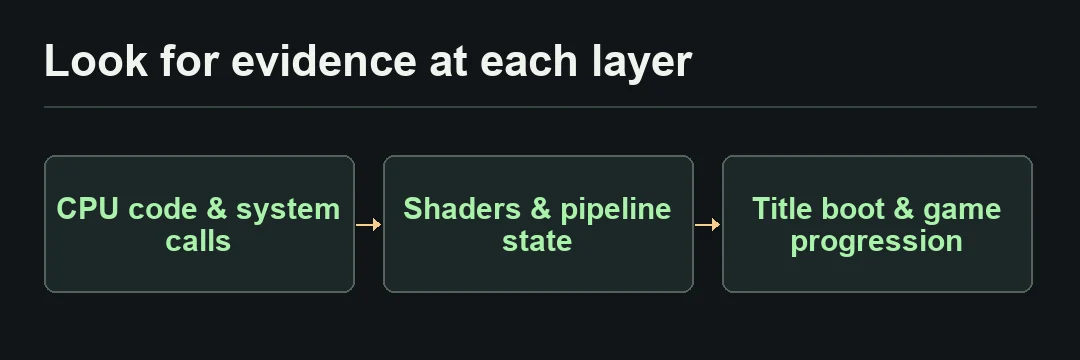
Ask what was measured before comparing results
Suppose you read that one project converted thousands of shaders and another compared output for hundreds. The first question is whether the experiment counted the same records. The second is whether both projects use the same success condition. Structural validation and rendering tests can use identical source records but check different properties. A rendering test that reports a matching output for one program is narrower than a claim that the game uses all graphics modes correctly. It is still stronger evidence for that exact program’s behavior than the fact that a validator accepted its representation.
A reproducible comparison starts with the original source links. Identify the revision, the test input and what the project did to obtain the result. If there is an adapter dependency, include the vendor, driver and feature level. Look for enough detail to repeat the test and distinguish observed facts from the project’s goals. Use the resulting evidence to answer the right question instead of deciding which project is generally ahead.
How to compare results from different backends
Record whether the control ran on hardware or a software adapter and whether the source expected a bit-for-bit result. Vulkan validation can catch an invalid operation without attempting execution. A Direct3D readback can expose a wrongly bound buffer even though the shader module is valid. If two tests fail at different layers, address each at the layer it measures. Try to carry one controlled test input across revisions before changing the adapter or format. A small, reproducible mismatch gives a maintainer a more useful starting point than a broad claim that the Windows conversion looks incomplete. Keep the date of your observations separate from the date of the commit that introduced the test.
What would justify a playability label?
A credible boot report would identify the title, build and environment and show the program reach an observable startup milestone. To earn a stronger playability claim, the evidence would need sustained interactive operation, useful controls and progress beyond a title screen. A repeat with the same inputs on a second supported configuration can help distinguish a general result from a system-specific observation. The maintainer would also need to publish instructions for the supported public test path.
Follow the comparison table for a quick view and the status board for dated evidence. Developers interested in exact fixed test counts can go straight to the experiment catalog. Readers waiting to play the game should follow the official PC release tracker. Those three pages track different milestones, and only the publisher can confirm its own PC release.
Common questions
Which project should Windows graphics testers follow?
Start with the specific workload you can reproduce. Xbox2Windows provides a published Windows diagnostic for selected fixtures, while Leonida documents Vulkan scenarios and XCL lists Windows Direct3D work. Use the maintainer's revision-specific instructions so a result can be interpreted in the right pipeline.
Do the projects use identical success criteria?
No. One may measure translated programs that pass a validator while another checks exact output on a controlled scene. For a useful comparison, preserve the input set, hardware, shader stage and reference result.
What proves a repeatable title boot?
Look for a source-identified revision, the tested operating environment and the specific scene the game reached. Someone should be able to reproduce it using an appropriate copy and instructions from the project. A compatibility claim extends further and should describe the interactive progression actually tested.